
Alex Berger · 18 September 2026
Decoding Intent Layers Through Adaptive Query Mechanisms in Modern Search Frameworks
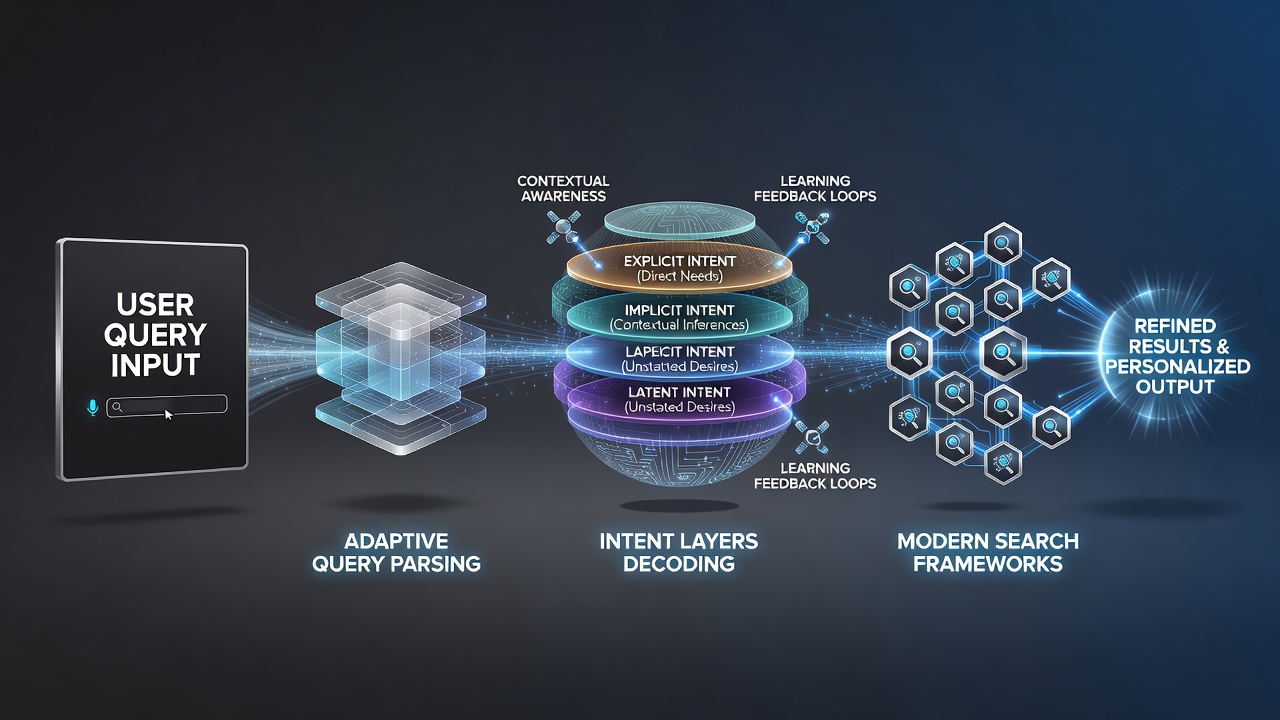
Modern search frameworks process user queries by breaking them down into multiple intent layers that range from surface-level keywords to deeper contextual signals such as location history and session behavior. Researchers at institutions across North America and Europe have documented how these layers combine to produce results that match stated needs while anticipating follow-up actions. Data from a 2025 industry report prepared by the Australian Digital Transformation Agency shows that frameworks incorporating at least four distinct intent layers reduced irrelevant result rates by 23 percent compared with earlier keyword-only systems.
Adaptive query mechanisms sit at the center of this process. They monitor incoming signals in real time and adjust weighting across layers without requiring a new search submission. When a user begins typing a phrase about travel planning, for example, the system may elevate geographic intent while suppressing commercial intent until the query clarifies further. Observers note that this adjustment happens through continuous feedback loops rather than static rulesets, allowing the framework to respond to shifts in user context within milliseconds.
Layer Construction and Signal Mapping
Intent layers form through a combination of linguistic parsing, entity recognition, and behavioral pattern matching. Linguistic parsing identifies verb structures and noun phrases, while entity recognition links terms to known databases such as place names or product identifiers. Behavioral pattern matching draws on aggregated session data to infer whether a query carries research, transactional, or navigational goals. Studies conducted at several Canadian universities in 2024 found that combining these three mapping techniques produced intent classification accuracy rates above 87 percent across tested languages.
Once mapped, each layer receives a dynamic score that adaptive mechanisms update as additional context arrives. A user who follows an initial query about flight schedules with repeated clicks on hotel listings triggers an increase in accommodation-related layer weighting for subsequent suggestions. This scoring approach avoids the need for complete query reformulation and keeps results aligned with evolving intent throughout a single session.
Real-Time Adaptation Techniques
Adaptive mechanisms rely on several coordinated techniques. Reinforcement learning models receive rewards when users engage longer with presented results, while graph-based structures connect related intent signals across different user cohorts. European Union research initiatives funded under the Horizon Europe program have published findings indicating that graph-augmented adaptation lowered average time-to-relevant-result by 31 percent in multilingual test environments. These models operate alongside simpler rule engines that handle edge cases such as explicit negative intent markers like “exclude” or “not interested in.”
September 2026 brings scheduled updates to several major frameworks that will expand the number of observable signals per layer. One planned change involves deeper integration of device sensor data, such as ambient light levels and movement patterns, to refine situational intent. Government agencies in Singapore and the United Kingdom have begun drafting guidelines that address privacy boundaries for these new signals while still permitting their use in non-personalized aggregate training sets.
Implementation Challenges and Observed Solutions
Scaling adaptive mechanisms across large indexes introduces latency and consistency concerns. Engineers address latency through tiered processing where lightweight models handle initial layer scoring and heavier models refine results only for high-traffic query clusters. Consistency issues arise when different geographic data centers apply slightly divergent layer weights. Industry groups such as the World Wide Web Consortium have released draft specifications aimed at standardizing layer metadata formats so that cross-region synchronization becomes more reliable.
One documented case involved a multinational e-commerce platform that encountered mismatched intent scores between its European and Asia-Pacific indexes. After adopting a shared metadata schema, the platform reported a 14 percent improvement in cross-region result parity according to internal metrics released in late 2025. Such outcomes illustrate how technical standardization efforts directly support the goal of accurate intent decoding at global scale.
Future Directions and Measurement Approaches
Measurement of intent layer effectiveness continues to evolve. Traditional click-through rates are supplemented by metrics that track multi-turn session success and downstream task completion. Academic papers from institutions in Japan and Brazil have proposed composite indices that weigh both immediate relevance and longer-term user goal achievement. These indices are now appearing in evaluation suites used by several commercial frameworks.
Regulatory bodies in multiple regions are also examining how intent layer transparency can be communicated to users without exposing proprietary model details. Early proposals suggest summary dashboards that describe which signals contributed most to a given result set. Implementation timelines remain under discussion, yet the direction points toward greater accountability in how adaptive mechanisms interpret and act upon layered intent signals.
Conclusion
Decoding intent layers through adaptive query mechanisms represents a core capability in current search frameworks. The combination of layered signal mapping, real-time scoring adjustments, and standardized metadata practices enables systems to deliver results that track shifting user goals across extended interactions. Ongoing work scheduled for 2026 and beyond will refine signal inputs and evaluation methods while regulatory frameworks develop in parallel to address privacy and transparency requirements.