Alex Berger · 16 October 2026
Resource Balancing Techniques Across Expanding Information Retrieval Systems
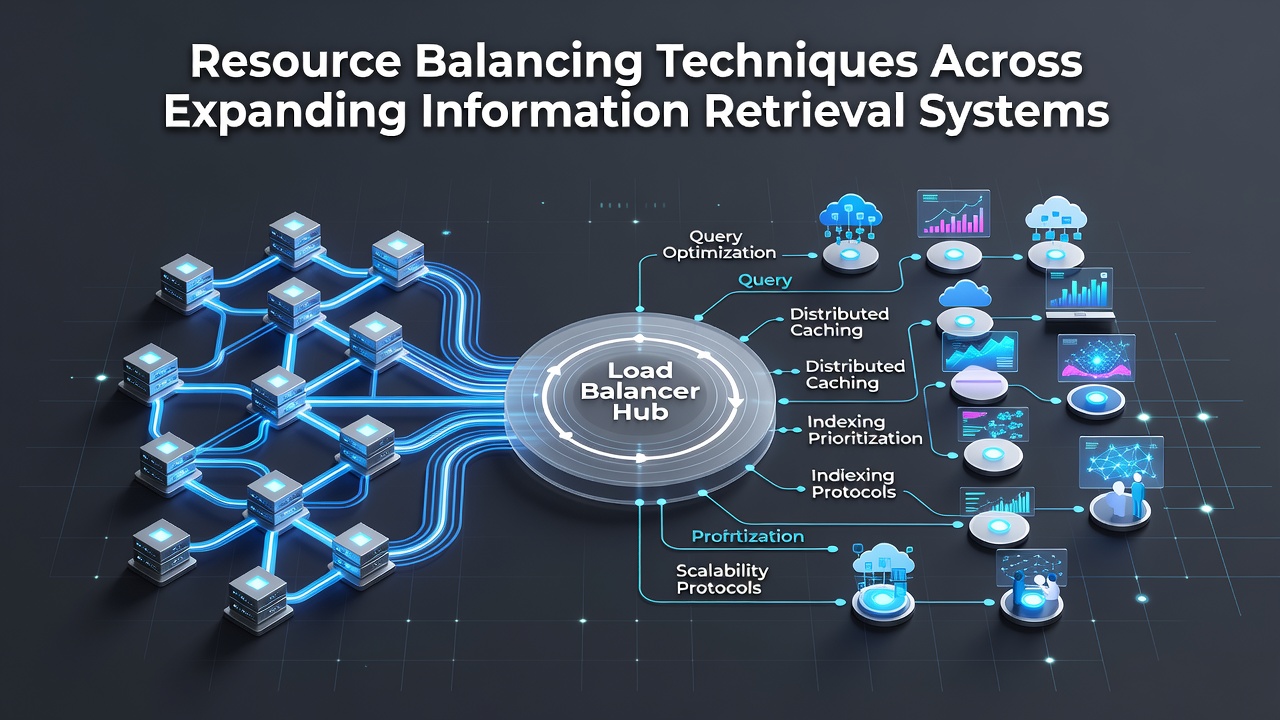
Information retrieval systems continue to grow in scale and complexity as data volumes expand across global networks, and resource balancing techniques address the resulting demands on processing power, storage, adn network bandwidth. Researchers have documented steady increases in query loads since the early 2020s, with patterns showing that distributed architectures now handle billions of daily interactions through coordinated node clusters. Data from various monitoring platforms indicates that unbalanced resource distribution leads to latency spikes and throughput bottlenecks in large-scale deployments.
Core Principles of Resource Allocation
Experts define resource balancing as the dynamic assignment of computational tasks to available hardware components, ensuring that no single node becomes overwhelmed while others remain underutilized. Studies from academic institutions reveal that effective techniques rely on real-time metrics such as CPU utilization, memory consumption, and I/O throughput to guide allocation decisions. Observers note that these methods often combine reactive adjustments with predictive modeling based on historical query patterns.
Partitioning strategies form a foundational element, where datasets split across multiple servers through sharding or replication mechanisms. Those who have examined production environments report that consistent hashing algorithms reduce data movement during node additions or failures, maintaining stability as systems scale outward. And researchers have measured improvements in query response times when partitioning aligns with access frequency distributions rather than uniform splits.
Load Distribution Mechanisms
Load balancers serve as intermediaries that route incoming queries to appropriate backend servers based on current capacity and content locality. Figures from industry reports show that round-robin and least-connection algorithms still see widespread use, yet more advanced systems incorporate machine learning models trained on traffic data to anticipate peaks. As of October 2026, several large retrieval platforms have integrated these models to handle seasonal fluctuations in user activity without manual intervention.
Cache management complements distribution efforts by storing frequently requested results closer to the query origin. Research indicates that multi-level caching hierarchies, spanning edge servers to central indexes, cut down on repeated disk accesses and network transfers. People who manage such systems often find that eviction policies based on least-recently-used or time-to-live values keep cache hit rates above 70 percent in tested configurations.
Scaling Strategies in Practice
Horizontal scaling adds more nodes to a cluster, while vertical scaling increases resources within existing machines, and both approaches require careful coordination to avoid synchronization overhead. Evidence from distributed systems research demonstrates that hybrid models, blending both methods, deliver better cost efficiency when query volumes grow unevenly across regions. One documented case involved a European academic network that shifted from purely vertical upgrades to a hybrid setup, resulting in measurable reductions in energy consumption per query processed.
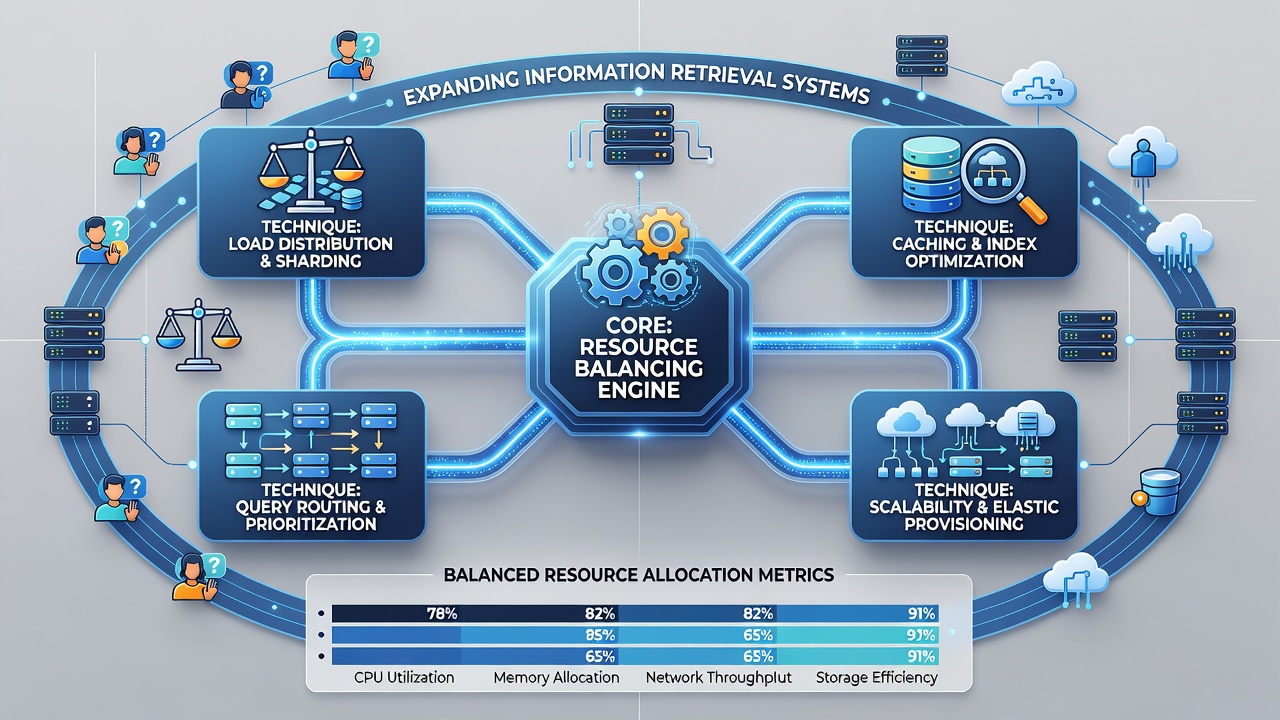
Monitoring tools play a central role by collecting telemetry from every component and feeding it into orchestration platforms. According to analyses published by the National Science Foundation, automated scaling policies triggered by threshold breaches maintain service levels during unexpected surges. Yet these policies demand tuning to prevent oscillation between over-provisioning and under-provisioning states.
Challenges in Heterogeneous Environments
Diverse hardware configurations across cloud and on-premises infrastructure introduce variability that complicates uniform balancing. Observers have recorded cases where legacy nodes with slower interconnects create drag on overall system performance, prompting the adoption of affinity rules that keep related tasks on compatible hardware. Data shows that such rules, when combined with container orchestration, reduce context-switching costs in mixed environments.
Security considerations also intersect with resource management, since encryption and access controls consume additional cycles that must factor into allocation calculations. Reports from the European Commission highlight how compliance requirements in data handling influence placement decisions across borders, often requiring localized processing that alters global balancing patterns.
Future Directions and Adaptations
Emerging techniques incorporate federated learning to optimize balancing across privacy-sensitive domains without centralizing raw logs. Those who study these developments point to incremental gains in efficiency when models update on decentralized data streams. And integration with edge computing further distributes retrieval tasks closer to data sources, shortening round-trip times in geographically dispersed setups.
Standardization efforts continue through bodies such as the European Commission working groups, which publish guidelines on interoperability for balancing protocols. These documents emphasize measurable benchmarks that allow operators to compare performance across vendors and deployments.
Conclusion
Resource balancing techniques evolve alongside information retrieval systems to sustain performance as scale increases. Data from multiple sources confirms that combinations of partitioning, caching, automated scaling, and monitoring deliver measurable stability under growing loads. Continued refinement of these methods supports reliable operation across expanding networks through October 2026 and beyond.