
Alex Berger · 30 October 2026
The Interplay of Query Tree Structures and Result Personalization in Scalable Retrieval Platforms
Query tree structures organize user requests into hierarchical nodes that break down complex searches into manageable subcomponents while result personalization adapts outputs based on individual profiles and historical patterns in large scale platforms. Researchers have observed these elements working together to improve efficiency across distributed databases and search infrastructures where data volumes continue to expand rapidly.
Tree based representations allow systems to parse queries into logical branches that represent filters, joins and ranking criteria and this approach supports parallel processing in clusters that handle millions of simultaneous requests. Personalization layers then modify traversal paths through these trees by incorporating user specific signals such as location preferences and past interactions so that the same base query yields varied result sets for different individuals.
Core Mechanics of Query Tree Construction
Engineers build query trees by starting with root nodes that capture the primary intent and then expanding into child nodes for attributes like date ranges or content categories and this structure enables pruning of irrelevant branches early in the retrieval process. Studies indicate that balanced tree designs reduce latency because they distribute computational load evenly across available nodes in scalable environments.
Adaptive mechanisms adjust tree depth according to query complexity and platforms often employ dynamic splitting when incoming requests spike during peak periods such as those projected for October 2026 at major data centers. Data shows that platforms using these techniques maintain consistent performance even as dataset sizes grow exponentially.
Integration with Personalization Algorithms
Personalization algorithms access user embeddings stored in separate indexes and they influence which branches of the query tree receive priority during execution and this interplay creates tailored experiences without requiring full re execution of every search. Observers note that embedding integration happens at specific decision points in the tree where similarity scores determine whether certain subqueries expand or contract.
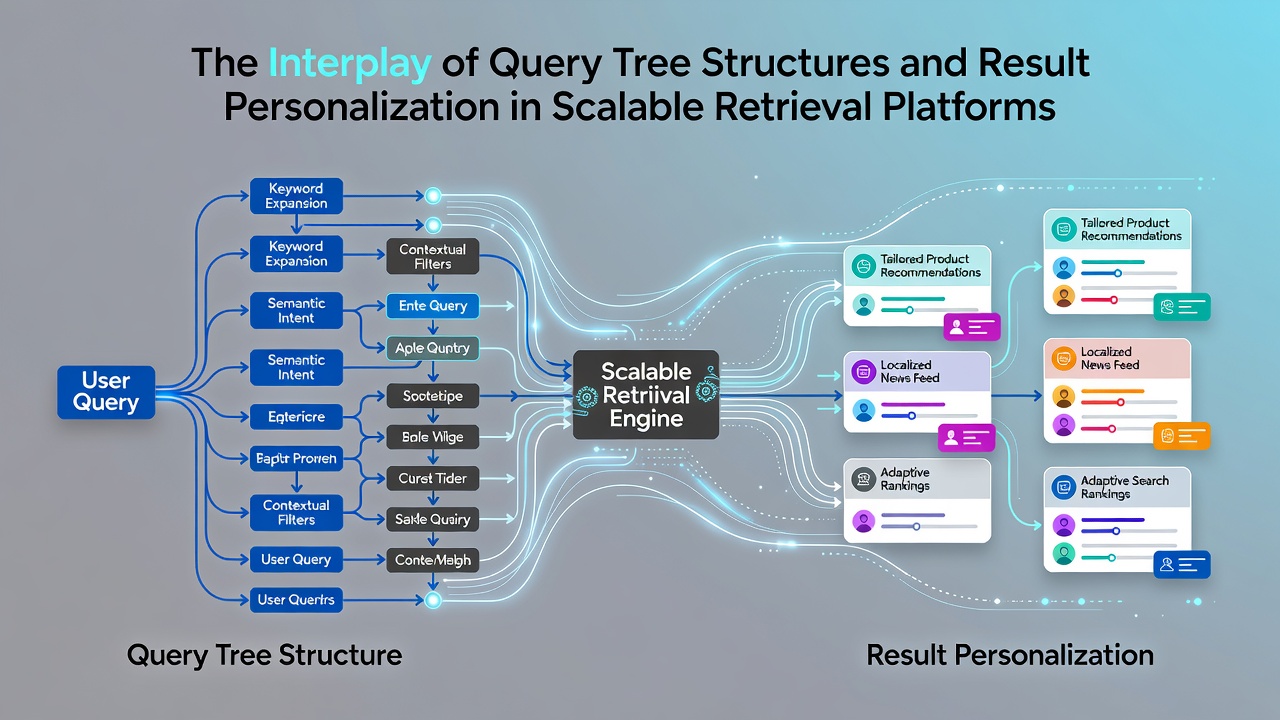
Take one case where experts analyzed a retail search platform that combined tree pruning with collaborative filtering and the system achieved higher click through rates by rerouting results toward user affinity groups while preserving overall recall metrics. Such examples demonstrate how the two components reinforce each other in production settings.
Scalability Considerations in Distributed Environments
Scalable retrieval platforms replicate query trees across multiple shards and they synchronize personalization data through eventual consistency models to avoid bottlenecks and this setup allows horizontal scaling when traffic increases. Research indicates that systems employing consistent hashing for tree node distribution experience fewer hotspots compared with simpler partitioning schemes.
Load balancers direct requests to the nearest replica while personalization modules pull real time updates from profile stores and the combination supports sub second response times even under heavy concurrent usage. Figures from industry reports reveal that platforms adopting these methods handle query volumes exceeding 100000 per second without degradation.
Challenges in Maintaining Consistency
Conflicts arise when personalization updates lag behind tree modifications and engineers address this through versioning protocols that tag each branch with timestamps and this approach ensures coherent outputs across replicas. Those who have studied these systems know that monitoring tools track divergence rates to trigger reconciliation processes automatically.
Security considerations also enter the picture because personalized paths can expose sensitive profile elements if tree access controls are not properly enforced and regulatory guidance from bodies such as the National Institute of Standards and Technology outlines best practices for protecting such data flows. Another source from the European Commission highlights similar standards for cross border retrieval operations.
Future Directions and Emerging Patterns
Developments in October 2026 are expected to include tighter coupling between query trees and graph based personalization models that capture relational data more effectively and early tests show improvements in handling ambiguous queries. Platforms continue to experiment with machine learning models that predict optimal tree configurations based on historical workload patterns.
Conclusion
The interplay between query tree structures and result personalization drives performance gains in scalable retrieval platforms through coordinated traversal and adaptation mechanisms and ongoing research continues to refine these interactions for larger datasets and diverse user bases. Evidence suggests sustained investment in these areas will support next generation search capabilities across industries.